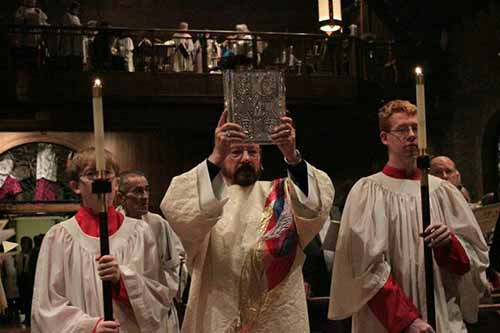
16 All Scripture is God-breathed and is useful for teaching, rebuking, correcting and training in righteousness, 17 so that the servant of God may be thoroughly equipped for every good work. (2 Timothy 3:16-17 NIV.)
This is a peculiar passage. This verse tells us all scripture is God-breathed, but it doesn’t give us a list of what those scriptures are. The Bible itself doesn’t provide such a definitive list. We modern Christians take for granted the table of contents in front of our Bibles telling us which books comprise it. But before the scriptures were compiled to become the volume we know today as the Bible, no such table of contents existed.
So how do we know which books should be considered scripture, and which books should not, if the Bible doesn’t clearly spell it out for us?
This became a major issue for the early Church. Around 150 A.D. the Marcion heresy was beginning to run rampant (The heresy that rejected the Old Testament and denied the incarnation of God in Jesus as a human.) Marcion began preaching that the Old Testament should not be read and that the God of the Old Testament isn’t the same God in the New Testament (Marcion and Getting Unhitched from the Old Testament; thegospelcoalition.org) .
As a response, and in the subsequent years, Church leaders would gather to discuss which writings could be affirmed as sacred (After all, at the time of Jesus, the only definitive writings all Jewish communities agreed were inspired were only the first five books of the Old Testament (The Pentateuch)).
There were many metrics used overtime to help the Church uncover the truth of inspiration. Here are examples of just a few.
- Authorship-whether the text was understood to have been written by an Apostle or by someone who had apostolic authority behind him;
- Content-whether the content of the documents conformed to the traditions handed on by the Apostles or contradicted them;
- The use of the texts in the sacred liturgies of the major churches founded by the Apostles (The Catholic Church & Sacred Scripture, Ignatius Catholic Study Bible, Jeffrey L. Morrow, Ph.D. pg. 21)
With this in mind, it didn’t take long for the Church to agree given the authorship of the Gospels, the apostolic authority of Paul’s letters, and other New Testament writings being used for teaching by the church as a whole, that the 27 books now comprising as the New Testament were indeed God-breathed.
The Old Testament however, was not as easy to discern. As I previously stated, when Jesus was still walking the earth the only writings all Jewish communities agreed upon was the Pentateuch.
The Sadducees only accepted the Pentateuch, Pharisees had a larger list which included the prophets, and the Essenes at Qumran where centuries later the Dead Sea scrolls would be discovered had other writings neither the Sadducees or Pharisees acknowledged.
That does not mean that only the Pentateuch was allowed to be read at the Synagogues. The readings in the Synagogues were varied. They just wouldn’t be officially canonized into the Jewish Bible until the late 2nd Century, though some scholars push that date possibly even to the 4th.
So what Jewish writings were being read and circulated? This brings us closer to the title question of this blog, is the Apocrypha scripture?
To answer this we must first have a short history lesson about the Jewish diaspora (The Jews dispersed from their original homeland). Before the birth of Christ many nations conquered the Jewish people and exiled many to new lands. These lands would later be conquered by Alexander the Great and the Greek language would become locally adopted.
Many Jews who made a home in these areas of the world lost the familiarity of reading or writing in Hebrew, but the desire to hold fast to their scriptures remained. One such group in Alexandria lived under the reign of King Ptolemy Philadelphus II 284-246 B.C. He commissioned 72 Jewish scholars 6 each from the 12 tribes of Israel to translate the Jewish writings into Greek. These writings would come to be known as the Septuagint, meaning seventy, in honor of the 72 Jewish scholars who translated the Hebrew writings into Greek.
The Septuagint would continue to be added to in the subsequent years and become widely used by the Jewish diaspora, and even read in synagogues in and around Judea. This translation became so popular that even the New Testament writers, when referring to the Old Testament, quoted from the Septuagint 80% of the time.
This brings us to the Apocrypha. What is it and why does it matter?
The Apocrypha are a collection of 7 Old Testament books found in both the Catholic and Orthodox Bibles.
The 7 Apocryphal books were translated into Greek along with the other Old Testament books in the Septuagint, and would be read in Greek speaking synagogues all over the ancient world.
The 7 Apocryphal books are as follows:
- 1st Maccabees
- 2nd Maccabees
- Tobit
- Judith
- Wisdom of Solomon
- Sirach
- Baruch
Here’s where things get interesting. Not only would the early Church canonize these 7 books as scripture (Council of Rome 382 A.D.), but some are alluded to in the New Testament. For example,
- Hebrews 11:35 refers to 2 Maccabees 6:18-7:42
- 1 Peter 1:6-7 refers to Wisdom 3:5-6
- Romans 1:18-32 refers to Wisdom 13:1-9
The early Christians were very successful at using the Septuagint (in particular the Apocryphal books) to spread the gospel.
Here is one such Messianic prophecy found in the book of Wisdom 2:12-20.
12 “Let us lie in wait for the righteous man,
because he is inconvenient to us and opposes our actions;
he reproaches us for sins against the law,
and accuses us of sins against our training.
13 He professes to have knowledge of God,
and calls himself a child[a] of the Lord.
14 He became to us a reproof of our thoughts;
15 the very sight of him is a burden to us,
because his manner of life is unlike that of others,
and his ways are strange.
16 We are considered by him as something base,
and he avoids our ways as unclean;
he calls the last end of the righteous happy,
and boasts that God is his father.
17 Let us see if his words are true,
and let us test what will happen at the end of his life;
18 for if the righteous man is God’s son, he will help him,
and will deliver him from the hand of his adversaries.
19 Let us test him with insult and torture,
that we may find out how gentle he is,
and make trial of his forbearance.
20 Let us condemn him to a shameful death,
for, according to what he says, he will be protected.”
Now, you tell me, who do you think this passage is referring to…?
This brings me to a short side bar where I would like to convince you that this passage is scripture and as a result the entire book of Wisdom. Deuteronomy gives us a clear test to know whether or not a prophecy is from God. Here is what it says.
If the prophet speaks in the Lord’s name but his prediction does not happen or come true, you will know that the Lord did not give that message. That prophet has spoken without my authority and need not be feared (Deut. 18:22.NLT)
Using that metric from the Bible it logically follows that the book of Wisdom is God-breathed and thus scripture. Wisdom 2:12-20 is a prophesy about Jesus, what His accusers will be like, that He calls God His Father, that He would be subjected to insult, torture, and a shameful death. All of which have come true. This prophecy passes the test from Deuteronomy, therefore showing that it is a message God has spoken, and with authority. (To dive deeper on this check out this link from Joshua Charles, Eternal Christendom https://eternalchristendom.com/becoming-catholic/articles/number-30/ )
Furthermore, have you ever wondered where the Jewish people got the celebration of Hanukkah, since it’s nowhere to be found in the Protestant Old Testament? It’s in 1st and 2nd Maccabees. Jesus celebrated Hanukkah as seen in John 10:22. It’s rather interesting that Jesus affirms an event that is only found in the Catholic & Orthodox Old Testament!
Circling back to the early Church. These 7 books were popular readings in synagogues all over the world. As many Jews converted to Christianity, they incorporated these readings into the Christian liturgy (church service).
Here are some examples of the early church referencing the Apocrypha:
Do not be someone who stretches out his hands to receive but withdraws them when it comes to giving [Sir 4:31] [Didache 4 (A.D. 50)]
By the word of his might he established all things, and by his word he can overthrow them. “Who shall say unto him, ‘What have you done?’ or ‘Who shall resist the power of his strength?’” [Wisdom 12:12] [Clement of Rome -Letter to the Corinthians 27:4-5 (A.D. 70)].
Stand fast, therefore, in these things, and follow the example of the Lord, being firm and unchangeable in the faith, loving the brotherhood [1 Peter 2:17]…When you can do good, do not defer it, because “alms delivers from death” [Tobit 4:10; 12:9]. Be all of you subject to one another [ 1 Peter 5:5], having your conduct blameless among the Gentiles [I Peter 2:12], and the Lord may not be blasphemed through you. But woe to him who blasphemes the name of the Lord [Isaiah 52:5]! [Polycarp of Smyrna – Letter to the Philippians 10 (A.D. 135)].
Therefore, in light of the metrics I discussed at the start of this blog, the Council of Rome, with full knowledge and understanding that the earliest Christians in churches founded by the Apostles from their inception read and revered these writings, decreed them God-breathed. Here’s a quote from the Council of Rome 382 A.D.)
Now indeed we must treat of the divine Scriptures, what the universal Catholic Church accepts…”Genesis, one book; Exodus, one book; Leviticus, one book; Numbers, on book; Deuteronomy, one book; Joshua [Son of] Nave, one book; Judges, one book; Ruth, one book; Kings, Four books [1 and 2 Samuel and 1 and 2 Kings]; Paralipomenon [ Chronicles], two books; Psalms, one book; Solomon, three books; Proverbs, one book, Ecclesiastes, one book, Canticle of Canticles [i.e., Song of Songs], one book; likewise Wisdom, one book; Ecclesiasticus [Sirach], one book; Isaiah, one book; Jeremiah, one book, with Ginoth, that is, his Lamentations…Job, one book; Tobit, one book; Esdras, two books [i.e. Ezra and Nehemiah]; Ester, one book; Judith, one book; Maccabees, two books [Decree of pope Damasus 2 ( A.D. 382)]
Here is a quote from Protestant church historian J.N.D Kelly on the Apocrypha and the early Church.
It should be observed that the Old Testament thus admitted as authoritative in the Church was somewhat bulkier and more comprehensive…It always included, though with varying degrees of recognition, the so-called apocrypha or deuterocanonical books. (Early Christian Doctrines, 53)
St. Augustine also emphasizes the Apocrypha as scripture on the basis of the third criterion I spoke on earlier (The use of the texts in the sacred liturgies of the major churches founded by the apostles.) Here’s what he wrote.
The key is divine origin, which the Septuagint has guaranteed by its usage in churches from apostolic times (City of God 18:43)
So let’s quickly recap.
- All scripture is God-breathed
- The Hebrew Scriptures were translated into a Greek collection of writings called the Septuagint which included the 7 Old Testament books known as the Apocrypha.
- When the New Testament writers quote the Old Testament it uses the Septuagint translation 80% of the time.
- The New Testament writers reference books from the Apocrypha
- Jewish Christians used passages like Wisdom 2:12-20 when evangelizing to other Jews to show that Jesus was the Messiah, and the book of Wisdom passes the test of a prophet from Deut. 18:22.
- Early Church Fathers quoted the Apocryphal books in their writings to churches.
- Church leaders would come to understand that the Apocryphal books were inspired and decree that they are sacred and should be used for teaching (Council of Rome 382 A.D.).
- The Christian canon of scripture would comprise of 73 books for 1200 years.
This brings us to the 16th Century and the Reformation.
Much could be said about the breadth of the Protestant Reformation and the many changes to Christianity that occurred as a result; Sola Scriptura, Sola Fide, Sola Gratia. Not to mention that there were multiple Reformations going on simultaneously and they were not united in the least, except perhaps in their contempt of Catholicism. Henry the VIII founder of the Anglican Church in England thought Luther was a heretic. Luther in Germany disliked John Calvin and famously refused to shake his hand when they finally met. But I digress. Today’s blog will focus on its impact with regards to scripture.
As the story goes, Martin Luther thought certain books were not on par with the rest of scripture, and decided they needed to be removed. But what most people today do not realize, is that he technically didn’t remove books per se, he demoted them in status.
Before Luther, all of the Apocryphal books were interspersed throughout the Catholic Old Testament. A quick search on google for the Latin Vulgate table of contents will show this.
What Martin Luther did, was gather up the 7 Apocryphal books, group them together, and place them in his new translation between the Old and New Testament.
Here is Luther’s preface to the Apocrypha in his first German Bible translation post Reformation 1534 A.D.
“Apocrypha, that is, books not considered equal to Holy Scripture, but which are still useful and good to read.” (1534 A.D.)
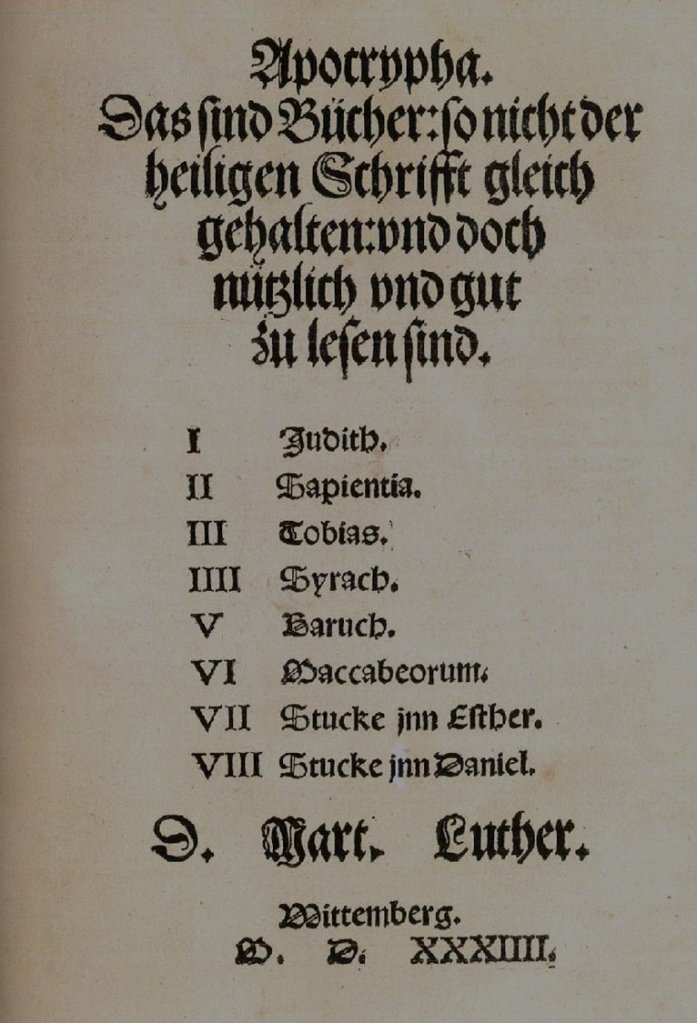
It was a shock for me to discover that Martin Luther kept the Apocrypha in the Bible. I wrongly assumed, like many modern Christians today, that the Bible I took with me to church on Sunday was essentially the same as the Reformers, a Bible without the Apocrypha.
So how unbiblical can a group of books really be if the original Reformers kept them in their Bibles and even encouraged Christians to read them?
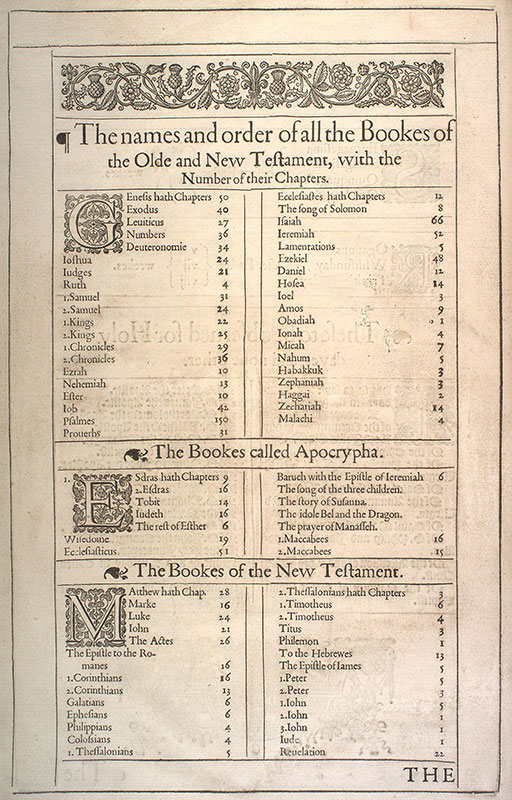
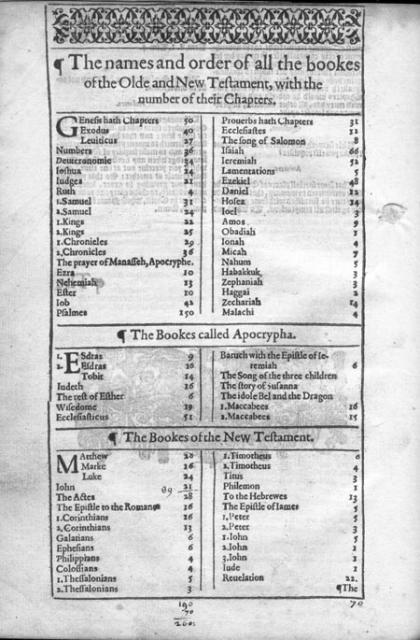
The original King James Protestant Bible included them, John Calvin’s Geneva Bible in Switzerland included them, and as stated earlier, so did Luther (See examples bellow).
In my 26 years as a Protestant these men were name dropped at least once in every church I’ve ever been apart of. Hailed as the defenders against corruption and returning the world back to original Christianity.
Well, the Mount Rushmore of Protestant Reformers want us to read these books, and I agree.
(Original King James Bible 1611 A.D., Table Of Contents With The Apocrypha)
(Original Protestant Geneva Bible 1560 A.D., With Apocrypha)
Fun fact, both the Anglican and German Lutheran churches still include the Apocrypha in their lectionaries.
So when did they get removed?
Would you be surprised if I told you it was the 19th Century?
In 1804 a group of Christians in England gathered to form what was called the British and Foreign Bible Society. A nonprofit, nondenominational publishing company dedicated to printing Bibles to the British and beyond.
The Society discontinued the printing of Bibles that included the Apocrypha in 1826 as a cost-saving measure to make Bibles more affordable and to distribute more copies of the Bible to the public. This decision was a significant factor in the widespread omission of the Apocrypha from Protestant Bibles throughout the 19th century and beyond.
So let me get this straight Luis. The only reason my Protestant Bible today does not have the Apocrypha is not because of Martin Luther, but because a 19th century Bible printing company were looking for ways to cut costs?
They both played a part…yes!
After this company started the trend, many other printing presses would soon follow. As time went on, generations of Christians like ourselves, would be taught it was the Reformers that removed these unbiblical books that no one should read. The fact that the decision was made by a printing press in 1826 would be lost to time.
But Luis, the Apocryphal books aren’t even in the Hebrew Bible the Jews use, so why should it be in ours!?
Surprisingly this is the biggest linchpin argument against the Apocrypha I’ve often heard as a Protestant, but one I would come to find is easily refutable.
Here’s my refutation…
…So what!!!
Yup, it’s that simple. “So what.”
That the Jewish bible today does not have the 7 Old Testament books called the Apocrypha is irrelevant. Here’s why.
The Jewish canon of scripture wouldn’t even be ratified until well after the 2nd century, over 200 years after the birth of the church.
The minute Jesus raises from the dead and breaths the Holy Spirit onto the Apostles, and gives them the authority to lead His church, ALL authority is passed to them. The preverbal vail is torn. Whatever the Jewish community chooses to do about what they think is scripture after the birth of the Church is irrelevant.
If we are commanded to follow everything the disciples taught whether by word of mouth or by letter (2 Thes. 2:14-17), and Jesus gives the Apostles and their successors the power to bind and loose (Matt. 16:19; 18:18), then what matters is what these successors declare.
When the successors in line with the Bishop of Rome and led by the Holy Spirit declared that there are 73 divinely inspired books, Jesus says it will be bound in heaven.
Therefore, no one has the authority to declare otherwise. Not an excommunicated monk from the 16th century, and certainly not a British printing press in the 19th.
We come back now to our title question. Is the Apocrypha scripture?
At worst they are not, but according to the Protestant Reformers are still useful and good to read! So read them.
At best, Yes. Jesus gave authority to the Apostles to bind and loose in perpetuity to their successors. Their successors in 382 A.D. at the Council of Rome proclaimed these 7 books to be inspired scripture along with the rest of the Old Testament and should be read to the church.
The book of Wisdom passes the test of true prophecy which means it was from God and authoritative according to Deuteronomy.
The earliest Christians read and revered these books corporately. The Early Church Fathers included quotes from the Apocrypha in their letters for instruction to major churches found in the New Testament like the Corinthians, Romans, and Philippians (The Fathers Know Best, The Canon of Scripture p160-162.)
Lastly, books like Maccabees and Wisdom are referenced in the New Testament.
One of the reasons I dearly love my Protestant friends is because of their love of scripture. A love they passed onto me and I am eternally grateful for it . But what if we’ve been kept from the FULL word of God? I would be furious, and I was, when I realized that there in fact are 7 more precious books that were wrongfully kept from me. But don’t take my word for it. Take the advice of the Protestant Reformers and read them. Find them online or purchase a Bible with the Apocrypha. Start with 1st Maccabees. Read for yourself the books that have been honored by the Church from the beginning and proclaimed as scripture along with the other 39 Old Testament writings! If it’s good enough for the early Church, it’s good enough for me.

Leave a comment