Hi my name is Luis Rodriguez, a former worship pastor that converted back to Catholicism after reading the writings of the early church fathers. Welcome to my blog Church Of The Fathers. Join me each week where I will break down what I learned about the early church and why it matters. If you find my content informative consider sharing this episode and help better inform people about what catholicism is and what it isn’t. Ok lets jump in.
Today I will be speaking on a crucial belief that I think every Christian should hold. It is a belief that even Jesus held about Himself, and every subsequent generation of Christians for 1500 years, until the protestant reformation in the 16th Century.
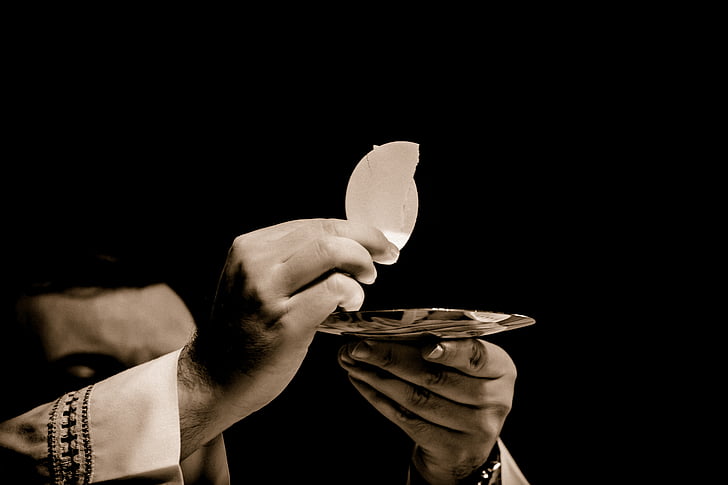
What belief am I speaking about? The real presence of Christ in the “Eucharist.” The Eucharist is often called by other names, “The Lord’s Supper”, or “Communion”. Some churches believe that when we partake in communion it is merely a symbolic representation of the body and blood of Jesus, and should only be taken as such. So which view is true? Is it the literal body and blood of Christ, or is it just symbolic? More on this in a minute.
So, there I was, sitting in bed one evening almost two years ago, about to start reading volume one of a series of books which contained the writings of the early church fathers, for fun. Yea I know, who reads ancient writings before bed and further still calls it fun? Well, apparently me! I was very much a Protestant Christian at the time, and the thought that Catholicism was remotely true didn’t even enter the farthest corners of my mind. All I was doing was curiously reading the writings of christians that lived a very long time ago.
Before I go any further it might be prudent to explain who the early church fathers were and their significants.
The Early Church Fathers were influential Christian bishops, writers, and theologians in the first six centuries who shaped core Christian doctrines by defending the faith, combating heresy, and clarifying traditions through their writings and teachings. Key figures include Clement of Rome and Polycarp, who were contemporaries of the apostles, followed by Justin Martyr and Irenaeus before the Council of Nicaea, and the Post-Nicene Fathers such as Augustine, Jerome, and John Chrysostom who lived afterward.
The writings of these men can not be understated. Especially the very early writings of Clement of Rome, Polycarp, and Ignatius of Antioch. These men were discipled by the actual Apostles and their writings give us great insight into the beliefs and traditions they went to the grave defending. I dare say if any of our modern Christian beliefs conflict with these men, it is our beliefs that should come into question, not theirs. Ok moving on.
As I began reading it didn’t take long for the topic of the Eucharist to come up. I thought to myself, “ooh this is great, I’m only a couple pages in, and this writer is already addressing what is a hot topic today.” Namely, what should we believe about the Eucharist, i.e communion, i.e the Lords Supper. With no modern in-fighting between us denominational Christians, it will be interesting to see what this ancient father of the church has to say without any of our current bias.
Here is a direct quote from Irenaeus of Lyons in southern France circa 189 A.D., I would later learn he was an incredible defender of the faith, an early christian apologist, and one who would later become my confirmation saint. Here is what he states about the Eucharist.
“He (meaning Christ) has declared the cup, a part of creation, to be his own blood, from which he causes our blood to flow; and the bread, a part of creation, he has established as his own body, from which he gives increase to our bodies. When the mixed cup [wine and water] and the baked bread receive the Word of God and become the Eucharist, the body of Christ, and from these the substance of our flesh is increased and supported, how can they say that the flesh is not capable of receiving the gift of God, which is eternal life—flesh that is nourished by the body and blood of the Lord, and is in fact a member of him?” (St. Irenaeus of Lyons, Against Heresies (Book 5, Ch. 2, 2-3) (c. 189))
Wow, “He has declared the cup to be His own blood, and the bread He has established as his own body!” That does not sound like symbolic language to me. Further still Irenaeus goes on to say how it is after the bread and wine receive the Word of God, that they become His body and His blood. Not unlike a catholic mass today, where the priest recalls the last supper repeats the Words of Christ to usher in the transformation of the bread and wine to become the body and blood of Christ.
“But Luis, that is just one quote. That is only one early church father.”
I’m glad you mentioned that. Here is another excerpt, this time from Origen, an early church father from Egypt.
Formerly, in an obscure way, there was manna for food; now, however, in full view, there is the true food, the flesh of the Word of God, as he himself says: “My flesh is true food, and my blood is true drink.” [John 6:56]” (Origen, Homilies on Numbers, 7:2 (c. 249))
Here we have an early church father even quoting the words of Jesus in John 6:56 to prove this belief comes from Christ Himself!
One last quote just to bring the point home. This time from the church father I would come to learn the protestant reformers most feared. Saint Ignatius of Antioch who lived in ancient Syria.
“Take note of those who hold heterodox opinions on the grace of Jesus Christ, which have come to us, and see how contrary their opinions are to the mind of God…They abstain from the Eucharist and from prayer because they do not confess that the Eucharist is the flesh of our Savior Jesus Christ, flesh that suffered for our sins and that the Father, in his goodness, raised up again. They who deny the gift of God are perishing in their disputes.” (St. Ignatius of Antioch, Letter to the Smyrnaeans (6-7) (c. 107))
Now Ignatius here is writing against a group of heretics called the Docetists, who denied the physical reality of Christ’s humanity and suffering. They believed Jesus was never human in any real sense and thus could not really suffer for our sins. As a result, they believed the Eucharist could not be the real body and blood of Christ, because Jesus was not really God in the flesh.
Of course as Christians we disagree with the Docetists; the incarnation of Jesus is a ride or die belief that is paramount to being a Christian. You can not believe in Easter, if you do not believe in Christmas.
Ok so by now you might be thinking. Luis, what about all the early evidence that the Eucharist is just symbolic. Don’t worry, I got you covered. Here are the early church quotes talking about how the Lord’s Supper was always ment to be interpreted as just symbolic and never to be taken literal………………………………..(a few moments later)
That’s right. There are none. This is an example of an instance where the early church was unequivocally united in view. Don’t take my word for it. Let’s here it directly from the reformer of reformers. Martin Luther himself. And I quote.
“Who ever read in the scriptures, that “my body” is the same as “this is a sign of my body?”…Not one of the fathers, though numerous ever said, “this is only bread and wine”; or, “this body and blood of Christ is not there present.”…Certainly in so many fathers and in so many writings the negative might at least be found in one of them had they thought the body and blood of Christ were not really present; BUT THEY ARE ALL OF THEM UNANIMOUS.” (Luther’s collected works, Wittenburg edition, NO. &, P.391)
And there you have it. The belief in the real presence of Christ in the Eucharist is THE view held by every Christian since the beginning of Christianity.
But what if this view was wrongly held since the beginning?
“Sure Luis, you’ve showed us that this is the historic view of the Eucharist held by every Christian until the reformation, but what if this view was wrong from the start?”
For this, I give you the best source I can possibly give. The words of Jesus Himself in the gospels.
52 Then the Jews began to argue sharply among themselves, “How can this man give us his flesh to eat?”
53 Jesus said to them, “Very truly I tell you, unless you eat the flesh of the Son of Man and drink his blood, you have no life in you. 54 Whoever eats my flesh and drinks my blood has eternal life, and I will raise them up at the last day. 55 For my flesh is real food and my blood is real drink. 56 Whoever eats my flesh and drinks my blood remains in me, and I in them. 57 Just as the living Father sent me and I live because of the Father, so the one who feeds on me will live because of me. 58 This is the bread that came down from heaven. Your ancestors ate manna and died, but whoever feeds on this bread will live forever.” (John 6:52-58 NIV)
We are called Christians because we are little Christs. We don’t get to pick and choose the things we believe about Jesus and the things we want to discard. We either believe what He says is true in its entirety and call ourselves Christians, or we don’t. Jesus is crystal clear in this passage about His view on what He would soon after institute in the last supper as His Real Presence in the bread and in the blood. He says whoever eats His flesh and drinks His blood will have life in them. He also states that whoever eats of it will remain in Him and He in them.
This brings me to what will be the most controversial point I will make today. Some of you might be thinking, wait a minute, everything you’ve just stated is highly controversial. What can be even more controversial than that? Well, let’s see!
If the early church can be trusted to have told us what the right view on the Eucharist should be (a view we have just learned was unanimous by the early church fathers), then what do they say about where we can go to receive the literal body and blood of Christ, the body and blood that Jesus claims in John 6 gives us life, and keeps Him abiding in us?
It is here we go back again to the ancient Christians for the answer. If you are listening or reading this and protestant, brace yourself, you might get sick to your stomach as I did upon reading this next quote. And I quote.
“Let no one do anything that has to do with the church without the Bishop. Only that Eucharist which is under the authority of the Bishop (or whomever he himself designates) is to be considered valid.” (Letter to the Smyrnaeans. Ignatius of Antioch. Circa 98 A.D.)
“Wow. Luis wait a minute, Ignatius just said that the only Eucharist that is considered valid is the one under the authority of the Bishop or someone he designates. But, my church doesn’t have any bishops!”
I know
“But He says not to do anything that has to do with the church without the Bishop!”
“Anything?”
Anything
“Literally anything?!
Anything
My friends, as many people said to Jesus, “this is a hard saying, who can accept it?!”(John 6:60)
I was sick. Sick sick sick to my stomach after reading this. And it only got worse as I read further, but more on that in just a minute.
Some of you at this point might be thinking. “Hey Luis this passage is totally cool with me because my church has a bishop, so I’m good. Our Eucharist is valid.”
It is here that we must read the next sentence I withheld earlier when quoting Ignatius of Antioch, where he further clarifies which church he is referring to. Keep in mind that at the time Ignatius is penning these words, the Apostle John (the beloved disciple of Jesus) is still alive. Even more significant and further still, is the fact that Ignatius was discipled by the Apostle John himself.
Though many protestants and modern cults claim there was a great apostasy, and the church fell away from the true faith, none claim it happened before the death of the last apostle, let alone by one of their disciples writing while they still lived.
So which church does Ignatius say holds the valid Eucharist, the real presence of Christ where we can; abide in Him and He in us, where if we consume it we will live forever?
Let’s read the Ignatius passage again but this time with the sentence succeeding it that I left out earlier.
“Let no one do anything that has to do with the church without the Bishop. Only that Eucharist which is under the authority of the Bishop (or whomever he himself designates) is to be considered valid. Wherever the bishop appears, there let the congregation be; just as wherever Jesus Christ is, there is the Catholic Church.” (Letter to the Smyrnaeans. Ignatius of Antioch. Circa 98 A.D.)
OMG. Did I just hear that right? Let me read that again.
“Wherever the bishop appears, there let the congregation be; just as wherever Jesus Christ is, there is the Catholic Church.” (Letter to the Smyrnaeans. Ignatius of Antioch. Circa 98 A.D.)
If we want to participate in communion/the lords supper/the eucharist, according to a disciple of John, it is under the authority of a Catholic Bishop. (For the sake of time and simplicity, Orthodox Christians do posses a valid Eucharist, but more on that in another episode).
I can’t stress enough how big of a statement this is from Ignatius.
Suffice it to say, according to our early church fathers, the structure of leadership directly correlates to the validity of the most consequential event Jesus told us to remember Him by. The Lord’s supper. An event that Jesus instituted. Where He broke the bread and gave thanks saying this Is my body. Where He raised the cup again giving thanks and said this IS my blood. And where earlier in His living ministry He told the crowd who ever eats My flesh and drinks My blood will have life in them. That He will abide in them and they in Him. That those who drink His blood and eat His flesh will live forever!
A serious claim that warrants serious consideration for all Christians.
So why would it be important to the early fathers that the direct line of succession be unbroken in order for one to consecrate the Eucharist. Well, they had to be sure that who ever was speaking in the name of Christ was someone who learned correctly from the disciples. This was the only sure way that a leader could be vouched for. Having a direct lineage right back to the apostles and only being ordained when other approved men saw your character and fruit. (The Early Church Fathers pg 4 David Augustine)
This brings me to my closing remarks
Beliefs matter. Beliefs have consequences. If you believe in the literal body and blood of Christ in the bread and wine, as Christ taught, it is no wonder you would revere it, and go to great lengths to treat it with the same honor and care that you would treat Jesus if He were standing right next to you, like Catholics do. It makes perfect sense then, that Catholics would also bow upon entering the church before sitting down. If you walked into a room where Christ was literally present, wouldn’t you bow to Him? If you believe at the moment a priest says the words of consecration, that the bread and wine literally become the body and blood of Christ during the mass, wouldn’t you be kneeling to usher in God’s presence?
However, if you believe it is merely symbolic and just bread and wine, you may be more cavalier about how you observe the Lord’s supper. You might even think it isn’t a big deal to offer it up freely to any in attendance, even a nonChristian. Here’s one last quote from the early church fathers on this point.
“We call this food Eucharist, and no one else is permitted to partake of it, except one who believes our teaching to be true and who has been washed in the washing that is for the remission of sins and for regeneration [i.e. baptism] and is thereby living as Christ enjoined…” St. Justin Martyr, First Apology (§66) (c. 151)
So How far are you willing to go for the truth? For me, I couldn’t ignore the early church evidence. I couldn’t ignore men who were discipled by the apostles.
I’M GONNA look back 2 thousand years later and in arrogance say these great men were wrong because it doesn’t line up with what I believe today? No.
The harshest persecution I’ve ever endured as a modern Christian were a couple harsh words spoken. These early christians were skinned, crucified, fed to lions and burned alive. They gave their life rather than turn their backs on Jesus and His teachings. Including His teaching on the Eucharist.
Wrestling with this historical evidence I knew I wanted to be in communion with these men. I wanted to partake in the real presence of Christ in the Eucharist. I wanted Christ to abide in me and I in Him. But that ment upending my life in the most dramatic way.
I left Catholicism at 17 and here I was 25 years later a protestant and a former worship pastor at that. What will people say. How many friends and family members will I loose. My family will be spiritually divided. Needless to say I was terrified. There were many sleepless nights and much mourning over the protestant christian life I would be leaving behind. But I knew I had to do it.
So again I say to all who are reading or listing to this podcast. How far are you willing to go for the truth? I’ve only touched on one main point today. I’m sure there are many objections one could raise about the church of the fathers that at face value could write off any legitimacy of it today. But on this issue, I hope I was able to show that to not hold the belief in the real presence of Christ in the Eucharist, is to go against the teachings of the early church, and that of Christ’s.
Protestants often reject Catholicism on the basis that Catholic beliefs are merely man made traditions and thus do not need to be followed.
So I’ll leave you with a question.
If on the one hand, the testimony of all the early church fathers point to the belief of the bread and wine being the literal body and blood of Christ from the beginning;
And on the other hand, the protestant idea of the bread and wine only being symbolic appears 1500 years after the church is born;
Whose belief then, is really a man made tradition?
Thank you for tuning into Church of The Fathers first ever episode. I know this first topic is controversial and a hard pill to swallow, it was for me. But I hope you have been shown at the very least that your Catholic friends are right about the real presence of Christ in the Eucharist and who knows, maybe you’ll come to learn they may be right about other beliefs as well. Ok friends meditate on this knowledge and let me know your thoughts, just remember to keep your comments respectful. See you next week.
Luis Angel Rodriguez Jr.
Church Of The Fathers

Leave a comment